A basic framework for tokenomics
It's about value flow.

Why do we need a token
Token is value medium of decentralized protocols and tokenomics decide how the value will be distributed. It has following edges compared with traditional financial assets.
Do old things better:
Permissionless: For public sales, almost everyone has the opportunity to participate. In traditional finance, investment opportunities are dominated by accredited investors and institutions. The normal early users or adopters can gain more benefits.
Efficient: Any token could be easily listed on a decentralized exchange(like Uniswap) with almost zero time and capital cost. In traditional finance, going public needs a long process with lots of considerations, including legal, regulatory and compliance problems
Transparent: Total supply, inflation rate and token distribution are completely transparent on-chain and every user can easily access.
Global market: Crypto is borderless and has a global user base from day 1
Do brand new things:
Decentralized governance: Token can serve as an important tool making all token holders able to engage in the governance process and decentralize the protocol. In traditional business, governance is concentrated on a few people.
Programmable: smart contracts enable tokens to possess infinite functions and utility. This is a brand new advantage compared with traditional financial assets like securities.
New relations of production: Token unleashes new interest alignment mechanisms which build on top of smart contracts. For example, liquidity mining from a lending protocol is just like acquiring equity of a bank as a reward when using bank services.
I believe that there are no one-size-fit-all tokenomics designs, but a basic analysis framework including basic dimensions exists for sure. Let's go. Generally, supply and demand are two sides to consider.
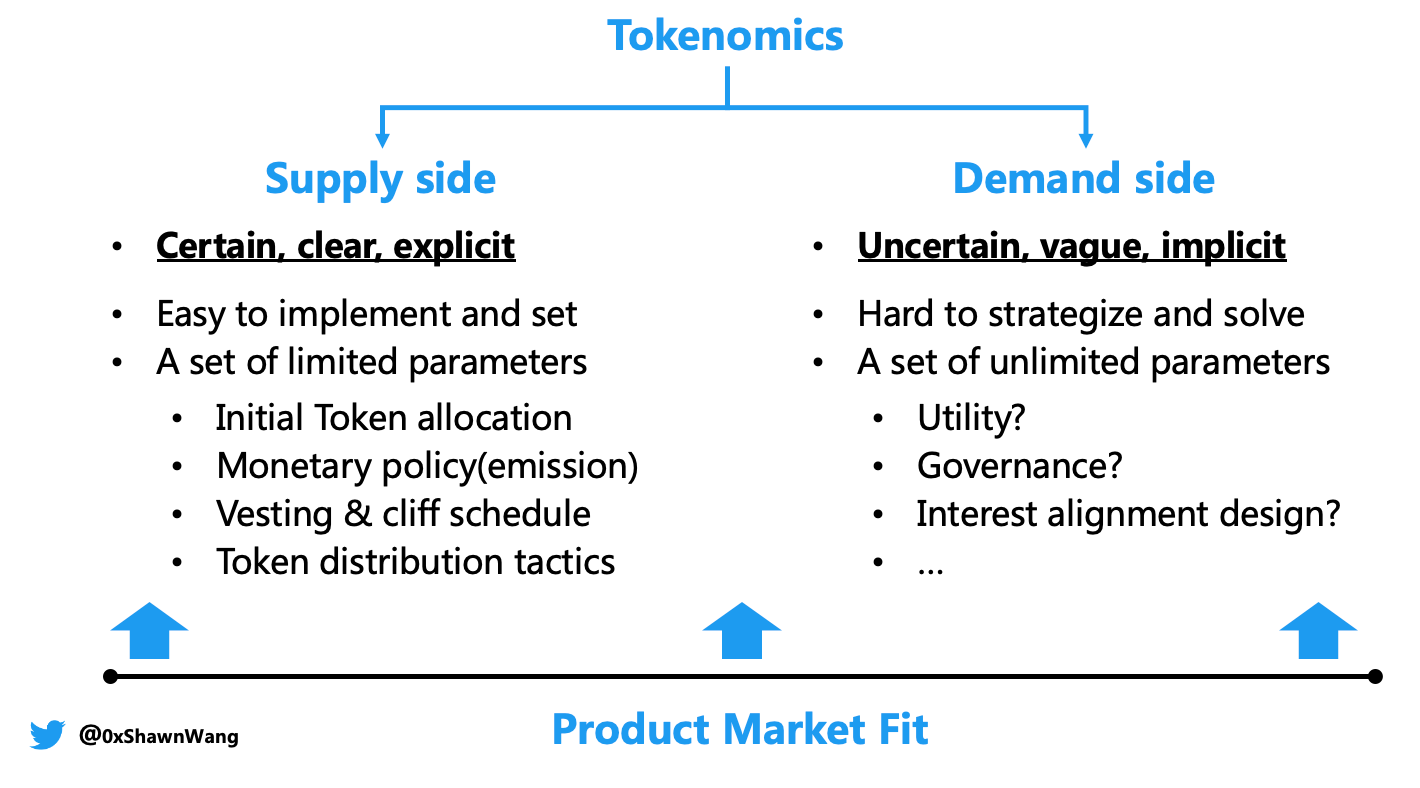
Supply Side
Initial token allocation
The initial token allocations distribute tokens to stakeholders like core team, insiders or private investors like VCs, ecosystem incentive and Foundations. The takeaway here is, the share of public sale has a clear decrease while the insiders and ecosystem incentive parts start gaining more share.
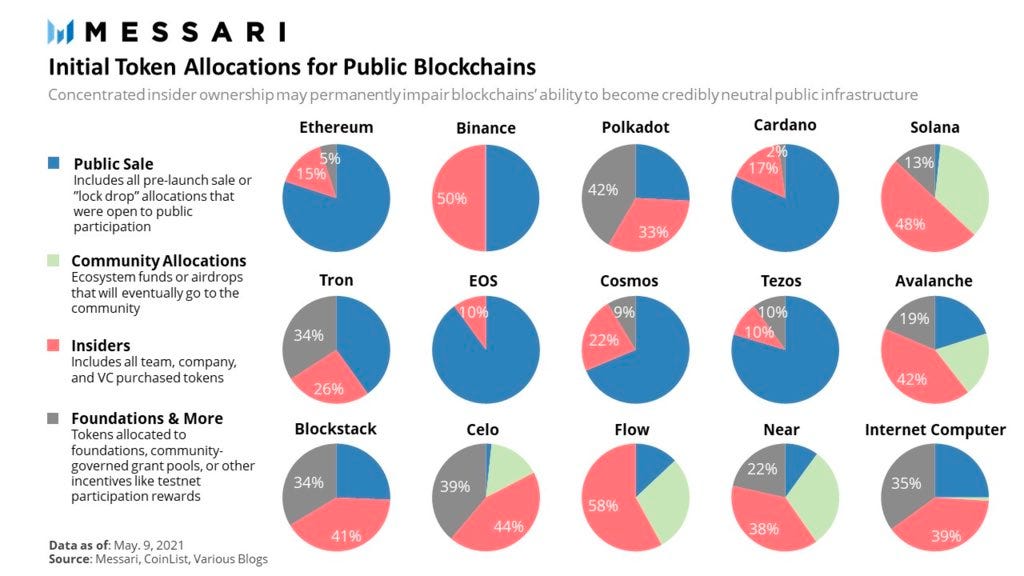
Obviously there is no one-size-fits-all and optimal token allocation. But the above-mentioned changes lead to new problems to consider:
The increasing portion of core team and private investor has a negative effect on decentralization of protocol
The so called "ecosystem incentive" and foundation portions are controlled by which party? It's community or core team?
What are trade-offs and consideration of balancing between rewarding the early participant and long-term incentive
Cliff and vesting period
Vesting period, also called the token lockup period, refers to a period in which tokens sold to investors and retained by core team are prevented from being sold for a specific period.
Having a well-designed vesting and cliff mechanism brings advantages:
The token investor could foresee the circulating market supply changes and have preparation to reduce the market price volatility and increase stability
The interests are well-aligned between core team and investor and direct all stakeholders to the long-term development and prosperity of the protocol
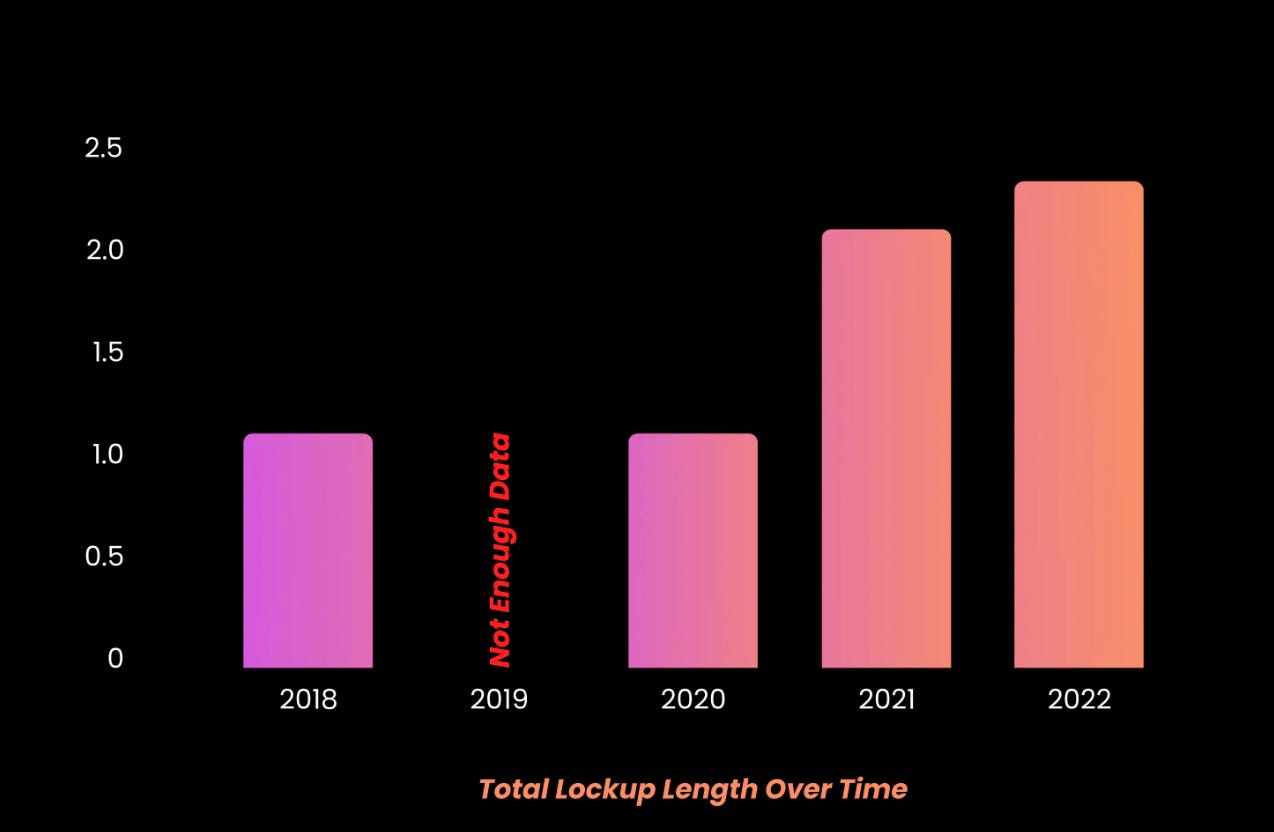
Currently, time based vesting schedule accounts for 30% share and trigger based vesting accounts for the rest 70%. The increasing lockup length may indicate that both founders and investors are willing to believe the long-term value of protocol and bear more risk.
Token emission
Token emission refers to the new issuance of crypto tokens. It acts as a monetary policy of crypto networks. Fixed supply, deflationary supply and inflationary supply are three types of emission model. For example, BItcoin has fixed supply, Ethereum has deflationary supply when the gas price is high enough and Solana is inflationary supply.
The goal of new emissions is trying to incentivize block producers via block rewards to security the blockchain network.
The token could also be burned (like transaction fees), which leads to a deflationary supply when the network is busy with strong block space demand.
FDV and Market capitalization
Market cap only takes into account the current circulating supply while FDV(fully diluted valuation) also factors in the maximum supply a token will ever have.
FDV = maximum supply of a token x current market price.(Note, FDV only apply to tokens with fixed supply).
Market cap = circulating supply of a token x current market price. The ratio FDV / Market cap could be a metric to evaluate a protocol's current market cap.
When a token's supply and FDV have little difference, it's a positive signal for investors since the potential inflationary pressure is decreasing. For example, Bitcoin has ~19M in circulation and 21M as a hard cap of supply. On the contrary, Serum is decentralized exchange on Solana which even has an FDV of $100 billion at the peak and it's even 1.25x the market cap of CME(Chicago Mercantile Exchange). Obviously, it makes no sense.
Demand side
Govenance
Governance is the most common factor to consider with respect to tokenomics. And token holders could engage in the decision-making about the protocol changes like fees flow and fund allocation. But the value of governance relies on the underlying protocol. The governance of Uniswap and MakerDAO are valuable while the governance of mediocre AMM copycats are worthless. Here are some common governance mechanism:
"One coin one vote" : The more token you have, the more governance power you have. This mechanism only considers the space dimension of token.
"veToken": Generally, voting power = token amount * lockup period. The longer periods you are willing to lock up, the more voting power you have. This mechanism considers both the space and time dimension. The locking process may improve participation of token holders and benefit more to the long-term stakeholders since the time value of "holding" has a payoff.
Car war exemplifies how "veToken" mechanism works. Basically, the CRV token becomes the key to direct liquidity and rewards in Cruve and CVX token becomes the key to control the majority of the CRV token. A layered governance structure has come into place and presents possibilities of how the governance mechanism could evolve.
The interests alignment mechanism designs are still in an early stage and immature. For example, if governance actions lead to bad results, which parties will be responsible and what's the aftermath of it? How should the feedback and accountability system be designed?
Utility
Utility is the factor driving token's organic demand. Token has following utility(William Mougayar):
Value exchange: The token is also an atomic unit of value exchange inside a particular market or app, resulting in the creation of a transactional economy between buyers and sellers. This consists of features that allow users to earn value and to spend it on services that are internal to the inherent ecosystem.
For example, users pay SLP and GST in Axis Infinity and StepN to buy virtual items in game.
The toll: Just like paying a toll to use a freeway, the token can be the pay-per-use rail for getting on the blockchain infrastructure or for using the product.
For example, users pay transaction fees to validators to transfer their tokens on bitcoin or ethereum networks; users pay Chainlink oracle service providers(node operators) with LINK token for their data services.
The function: The token can also be used as a lever to enrich the user experience, including basic actions like joining a network, or connecting with users.
For example, NFTs could form a community with members holding the same NFTs collections. Some token could also act as a pass or ticket to some activity.
The currency: The token is a very efficient payment method and transaction engine of choice. This is key for enabling frictionless transactions inside these closed environments.
For example, ETH functioned as a native trading currency in Ethereum ecosystem and BNB is the same for BNB chain ecosystem.
The earnings: An equitable redistribution of the resulting increased value is part of what blockchain-based models can enable. Whether it is profit sharing, benefits sharing or other benefits. More specifically, we can further breakdown the benefit share mechanism into "on-chain" and "off-chain".
For example, xSushi provides you with yield sharing from Sushiswap's trading fees and all steps are on-chain. Binance will buy back and burn BNB from the circulating supply to benefit BNB holders and it's off-chain and more indirect.
Tow token model
For a blockchain game, if a single token plays two roles as both the governance token and utility token, there are some tricky problems:
The existing token holders want a higher token price and continuous token appreciation while the high token price increases the entry barriers for onboarding of new users.
The fierce volatility of token prices could threaten protocol governance and destory stability and gaming experience to impede growth.
Take an analogy to explain, governance token is more like equity of a game company and the utility token is more like the virtual currency within the game the company developed. It's hard to imagine these two tokens are the same. Therefore, a tow token model is reasonable for a blockchain game use case and a tailed token design is necessary. For example, the two most phenomenal bitcoins games Axis Infinity and StepN both adopted a dual token model which is one token for governance and the other one for in-game function.
The future may not be limited to the two-token model and new mechanisms will play out.
Fundamentals always win
The analysis of fundamentals should be the first priority instead of paying disproportionate attention to tokenomics since it's more understandable. Sometimes a great product even has no token. For example, Uniswap functioned well and dominated the DEX sub-sector in case of no token issuance until the vampire attack from Sushiswap; Opensea pioneered and led the NFTs marketplace with no token issuance even today.
The origin of the whole reasoning process is the fundamental value of the products or protocols. Well-designed supply tokenomics are worthless without a strong product market fit. The sustainable and organic demand from the market overweights accurately-tuned supply mechanism. Tokenomics doesn't generate value, it just captures and directs value created by the underlying protocol or products.